INERTIAL LOGIC INDEPENDENT AI LAB

ATLAS / FLAGSHIP INTELLIGENCE SYSTEM

Autonomous Thought, Logic & Action System

Intelligence that
inhabits the whole picture.

From the room you are in to the organization you lead. Atlas pursues a continuous intelligence layer that notices, reasons, and acts across the full shape of your life. It is designed less as an application you open and more as a presence that is already oriented: aware of context, mindful of who is nearby, and clear about what it is permitted to do.

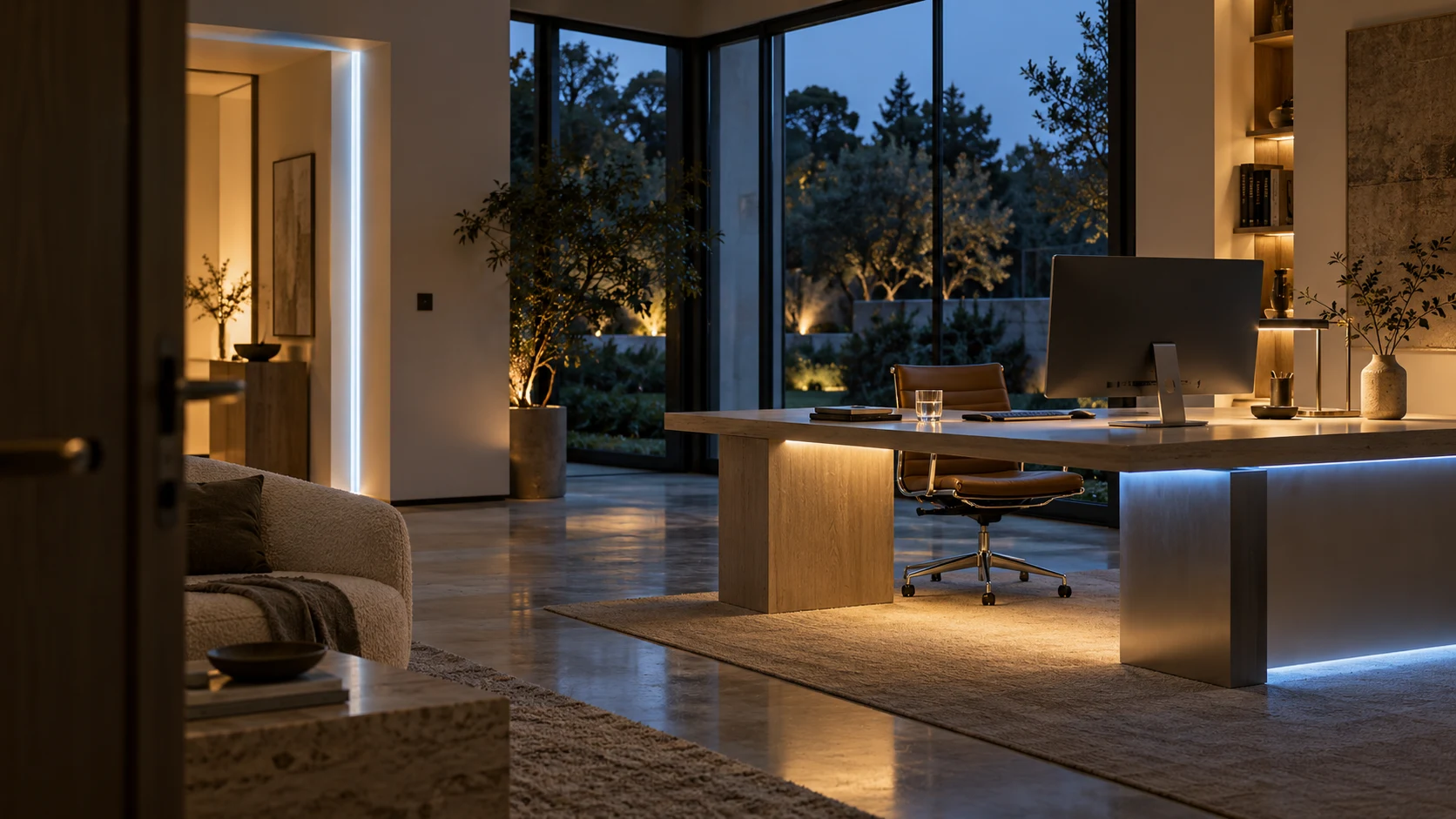
Quiet architectural workspace opening onto a shared living space at blue hour.
ATLAS / CONTEXT EXTENDS BEYOND THE SCREEN
PRESENCE. CONTINUITY. DISCRETION.

The room changes.
The understanding carries forward.

Before the request.
Beyond the response.

The most useful intervention may arrive before a question is asked. A conflict resolved before it reaches the calendar. A dependency noticed before it delays a launch. A quiet preparation for the decision tomorrow will require.

Most software waits to be told what to do. Atlas is designed to begin earlier, by holding a working understanding of what you are trying to accomplish and measuring the world against it. When something shifts, whether a delayed shipment, a double-booked afternoon or a figure that no longer reconciles, it already knows why that matters and who needs to hear about it.

The Atlas design thesis is anticipatory agency: recognize the distance between the present situation and the intended outcome, then prepare the next useful step. Persistent context connects events that would otherwise remain separate.

Its scope follows permission. It can prepare broadly, act within delegated authority, and bring consequential decisions back to the person responsible.

Restraint is part of the design. Atlas is meant to know the difference between preparing something quietly and interrupting someone loudly, and to choose the quieter option unless the moment demands otherwise.

AMBIENT CONTEXT

PRESENCE IS PART OF THE PROBLEM

The same answer.
A different room.

SPATIAL AWARENESS

Know where to meet you.

With permissioned presence signals, the system can recognize which room you are in, which interface is nearby, and whether spoken, visual, or silent delivery fits the moment. The same answer can be spoken aloud in the kitchen, shown on a screen at the desk, or held back entirely during a meeting. The content stays constant; the delivery adapts.

AUDIENCE AWARENESS

Know who might hear.

An audience-confidence layer considers who may be within earshot. Sensitive context moves to a private surface; uncertain presence leads to a quiet question rather than an exposed answer. Privacy is treated as a property of the moment, not a setting buried in a menu.

CONTINUITY

Carry the day forward.

A conversation started at a desk can resume elsewhere with its purpose intact. Context follows an authorized identity, with clear ways to pause presence, forget a detail, or end a session. Nothing follows you without permission, and everything it carries can be set down.

THE DIRECTION

A system capable of coordinating an enterprise.
Attentive enough to know when to whisper.

An organization.
A coherent intelligence.

The enterprise-scale goal is an intelligence system capable of coordinating a corporation’s operating rhythm—from strategic intent to daily execution.

Finance, operations, engineering, and planning become connected views of the same mission. Atlas would surface dependencies, prepare decisions, assign bounded work, reconcile outcomes, and maintain an accountable record across long horizons.

A human organization stays aligned through meetings, status reports and institutional memory. Atlas is designed to hold that alignment continuously. Teams keep their judgment and their ownership; the system keeps the thread.

Enterprise-scale coordination remains a long-horizon research goal. Authority stays explicit throughout: spending limits, external commitments, personnel decisions, and irreversible changes all require the appropriate mandate, and Atlas is built to ask rather than assume.

ONE DAY / ONE CONTINUOUS CONTEXT

EXAMPLE SCENARIO
07:40

Prepared before the first question.

A supplier slips a delivery overnight and the week’s priorities quietly change. Before anyone has asked, Atlas assembles the relevant context, traces what the delay touches, and prepares a revised plan for review, with its reasoning attached.

ANTICIPATION
12:15

A private answer in a shared space.

A sensitive question arrives just as a colleague walks in. Atlas notices the change in the room, holds the answer back, and moves it to a personal display, where it waits until the moment is private again.

AUDIENCE AWARENESS
18:30

The mission outlasts the meeting.

Decisions made in the afternoon meeting become bounded pieces of work with owners and limits. By evening, outcomes return with evidence, the questions still open, and the next decision that needs a human.

INTENT CONTINUITY

THE COMPUTE LAYER / ATLAS

Intelligence,
up close.

Intelligence at this scale is hard to picture, so these two studies bring it down to the size of a single rack. The first follows Aether’s expert routing: a 1.1-trillion-parameter model deciding, token by token, which specialists to consult. The second shows the fabric beneath it, a fleet-wide view of the capacity that makes selective reasoning at this scale practical.

Hardware renders and telemetry shown are representative visualizations, not a live system connection or a measured performance claim.

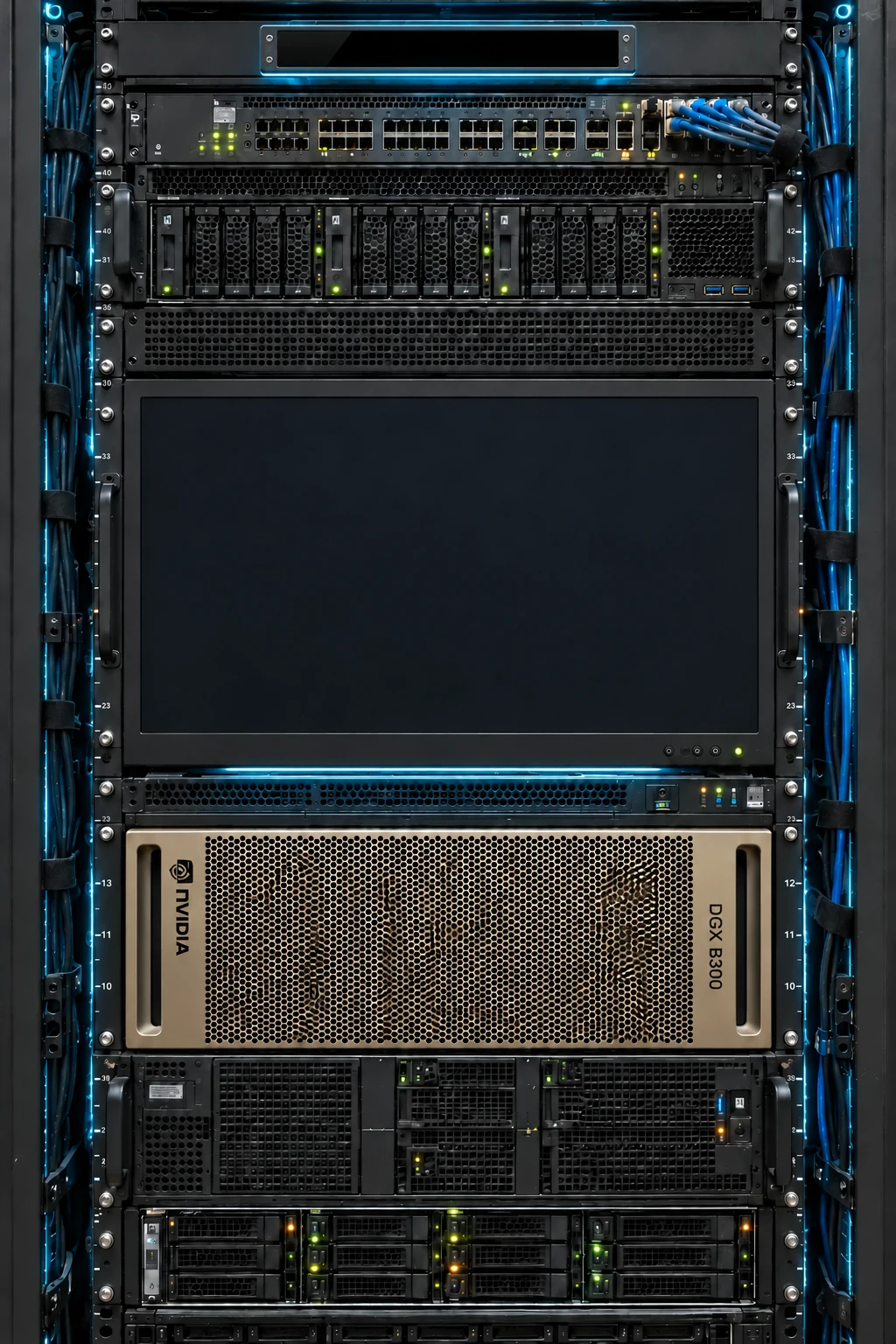
Close-up ATLAS-01 inference server rack with a softly illuminated nameplate, integrated monitor, and NVIDIA DGX B300-style module
ATLAS-01
ATLAS / LATENT COMPUTE OBSERVATORY● ROUTING
AETHER 1.0 / MODEL PROFILE1.1TTOTAL PARAMETERS
ACTIVATION FIELDAGGREGATED LAYER PROJECTIONSCYCLE 004,096
EMBEDATTENTIONEXPERT ROUTINGPROJECT
EXPERT ACTIVITY
LOW ━━━━━ HIGH
RESIDUAL STREAM / ACTIVATION ENERGY
MOE / TOKEN ROUTE EXPLORATIONILLUSTRATIVE AGGREGATES · SYNTHETIC
ATLAS-01 / INFERENCE SYSTEM STUDYILLUSTRATIVE HARDWARE · SYNTHETIC DISPLAY
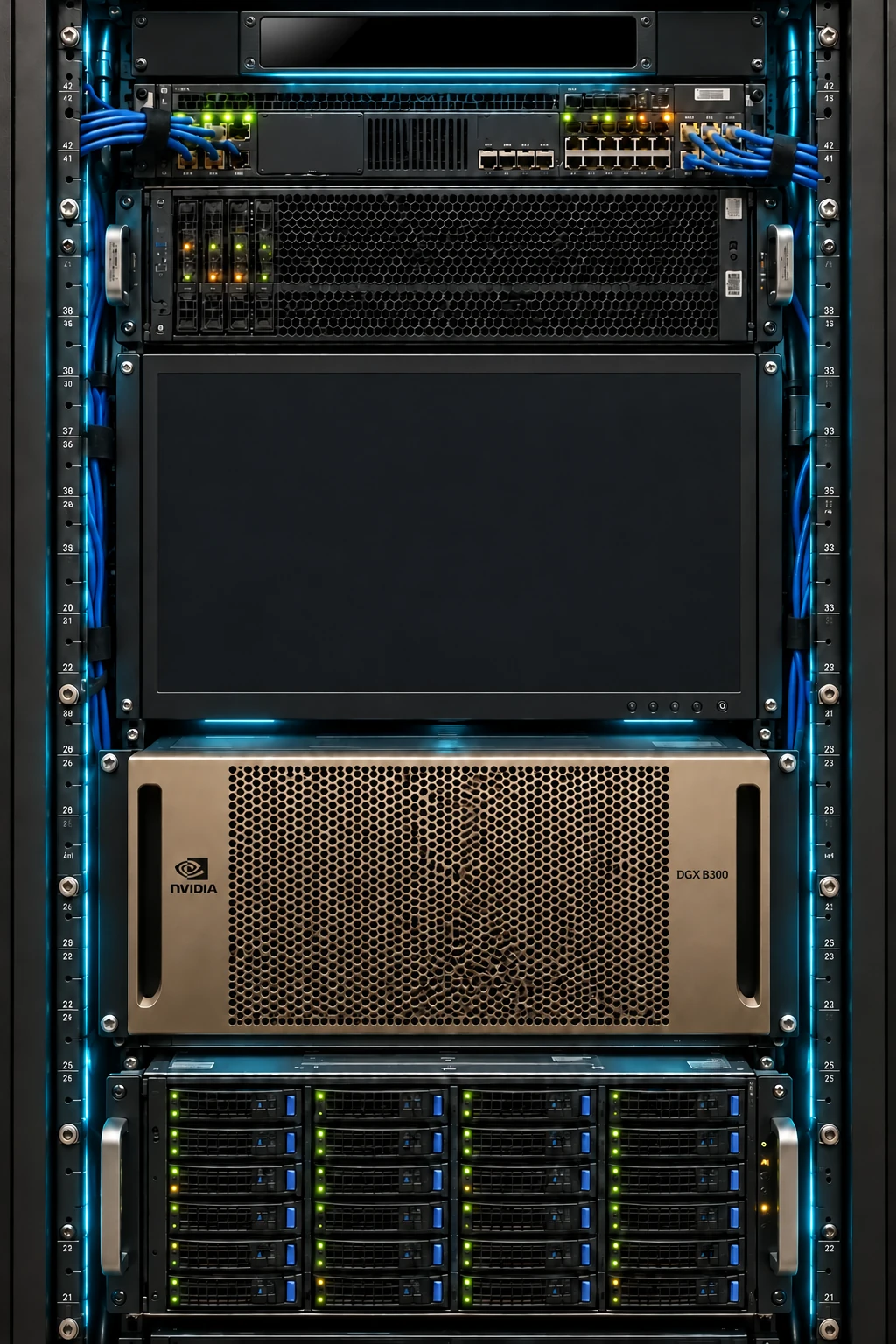
Close-up ATLAS-02 inference server rack with a softly illuminated nameplate, integrated monitor, and NVIDIA DGX B300-style module
ATLAS-02
ATLAS / DISTRIBUTED COMPUTE FABRIC● FABRIC NOMINAL
NVIDIA BLACKWELL ULTRA1,024 B300 GPUs
128 × DGX B300
ILLUSTRATIVE FLEET
16,384CPU CORES / INSTALLED
512 TBHOST RAM / CONFIGURED
268.8 TBGPU MEMORY / RATED
NODE AVAILABILITY / 128-NODE VIEW
PER DGX B3008 × NVIDIA B3002 × Xeon 6776P14.4 TB/s NVLink*8 × 800 Gb/s ports
VENDOR SPECS + EXAMPLE CONFIGURATIONSYNTHETIC FLEET / NOT LIVE
ATLAS-02 / INFERENCE SYSTEM STUDYILLUSTRATIVE HARDWARE · SYNTHETIC DISPLAY
Display notes & hardware references

The activation field is an aggregate visualization of the 1.1T MoE model, not a literal weight map. The fleet screen models a 128-node DGX B300 configuration: 8 B300 GPUs, two 64-core Xeon 6776P CPUs, and a 4 TB host-memory configuration per node. That gives 1,024 GPUs, 16,384 CPU cores, and 512 TB host RAM. GPU memory uses NVIDIA’s published 2.1 TB per-system rating: 268.8 TB across this fleet. Host RAM and GPU memory are separate pools. *14.4 TB/s NVLink is an aggregate within each node, not a cluster-wide fabric speed. Fleet quantities and availability indicators are representative figures, not measured capacity.

Hardware references: NVIDIA DGX B300 specifications, NVIDIA system guide, Intel Xeon 6776P.

SYSTEM INTELLIGENCE

MODEL FAMILY

The right mind, at the right moment.

Lyra answers at the speed of intent while Titan reasons in parallel, linked by a confidence envelope that lets the family change course mid-turn. Aether contributes sparse expert depth when a problem needs specialists, and Argo carries software work into Forge.

CONTEXT FIELD

Memory with a point of view.

The Atlas Context Field is designed to keep observations, interpretations, and permissions distinct. New evidence can revise a belief without silently rewriting its history. Atlas can say what it saw, what it concluded, and what it was allowed to do, as three separate things, which makes its reasoning something a person can audit rather than simply trust.

INTENT CONTINUITY

A purpose that outlasts the task.

Atlas is designed around a common intent ledger across models, tasks, and time. Every action has a reason; every result has somewhere to return. Whichever model does the work, and however long it takes, the original objective stays attached, so the answer that comes back is the answer to the question that was actually asked.

ATLAS </> FORGE

When intent becomes software.

The same intelligence philosophy, expressed through Argo and the Hydra code engine. Atlas Forge applies the same discipline to software: understand the whole system, keep the objective attached to every change, and verify the result before it is trusted.

Inside Atlas Forge